
Veneers cost between $250 and $2,500 per tooth, depending on the material. Composite veneers run $250 to $1,500 per tooth, while porcelain veneers typically cost $900 to $2,500 per tooth, with a national average near $1,500 to $1,800. A full set of six to eight veneers usually totals $6,000 to $20,000, since veneers are priced individually rather than as a flat fee.
That range is wide because veneers are not sold as a single product. Every tooth gets its own shade match, its own prep work, and its own lab fee. The number that lands on your treatment plan depends on choices you and your dentist make together, not a fixed price list.
Below, we will walk through what actually moves the number, how porcelain and composite compare, what a full smile makeover runs, whether insurance ever helps, and how patients at Oxboro Family Dental typically pay for the difference.
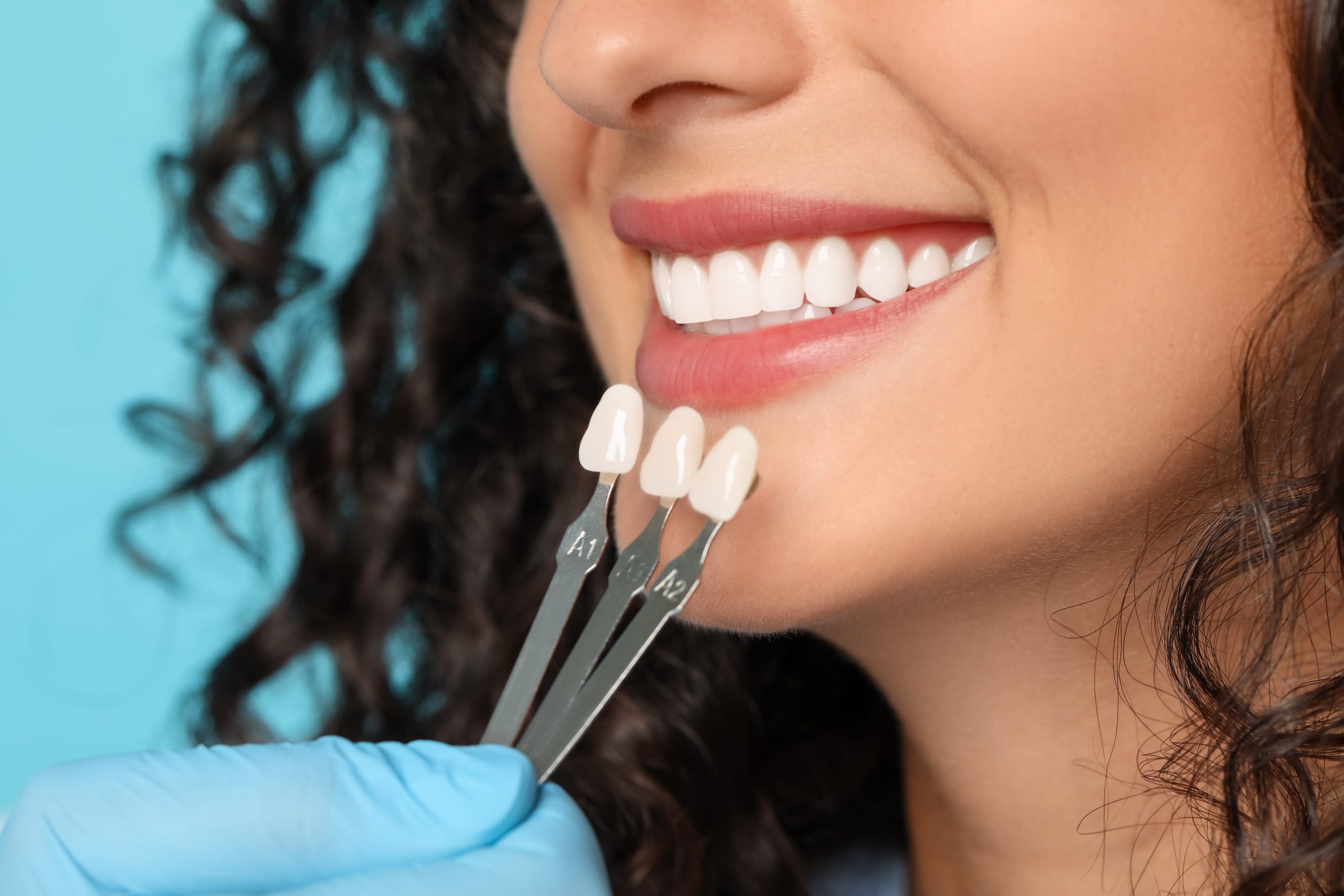
What Determines How Much Veneers Cost?
Four factors do most of the work in setting your price: material, number of teeth, prep involved, and who is doing the work.
Material is the biggest swing factor. Composite resin costs less because it is built and shaped directly on the tooth. Porcelain costs more because each shell is custom fabricated in a lab from an impression of your teeth.
Number of teeth matters more than most people expect going in. A single veneer to fix one chipped incisor might run $1,200. Eight veneers across your smile line multiply that per-tooth cost, which is why a full makeover quote can look shocking next to a single-tooth quote for the exact same material.
Prep work adds cost before the veneer itself. If a tooth has decay, old fillings, or gum inflammation, that needs to be addressed first. Skipping this step to save money is how veneers fail early.
Who places them affects price too. A prosthodontist, a dentist who has completed additional training specifically in restorative and cosmetic tooth replacement, will often charge more than a general dentist for complex cases. That additional training tends to show up in how well the final result blends with the rest of your smile.
If you are weighing veneers against other cosmetic dentistry options, the material and tooth count questions come up in every consultation, so it helps to have a rough number in mind before you walk in.
How Much Do Porcelain Veneers Cost Per Tooth?
Porcelain veneers typically cost $900 to $2,500 per tooth, with most patients landing closer to $1,500, according to CareCredit’s national pricing data.
Porcelain sits at the higher end for a reason. Each veneer is fabricated in a dental lab from a custom mold of your prepared tooth, which takes skilled lab work and usually two to three weeks of turnaround. The material itself resists staining far better than composite and holds its shine for 10 to 15 years with reasonable care.
The process behind that price:
- Your dentist removes a thin layer of enamel, generally around half a millimeter, to make room for the shell
- An impression or digital scan goes to the lab
- You wear a temporary veneer while the permanent one is fabricated
- Your dentist bonds and polishes the final veneer at a second visit
We walk through this in more detail on our porcelain veneer page, including what the placement appointment feels like.
Where you fall in that $900 to $2,500 range usually comes down to how much correction each tooth needs. A veneer covering minor discoloration costs less than one correcting a significant chip or reshaping a crooked tooth.
How Much Do Composite Veneers Cost Per Tooth?
Composite veneers cost $250 to $1,500 per tooth, roughly half the price of porcelain for the same tooth.
The savings come from the process. Composite resin, the same material used for dental bonding, is sculpted directly onto your tooth in a single visit. There is no lab fee, no temporary veneer, and often no second appointment.
That lower cost comes with real tradeoffs. Composite is more prone to staining over time, and its typical lifespan runs four to eight years compared to a decade or more for porcelain. It also does not reflect light quite the way natural enamel or porcelain does, which can be noticeable up close.
Composite makes the most sense when:
- You want to test out a smile change before committing to porcelain
- The correction needed is minor, like a small chip or a hint of discoloration
- Budget is the deciding factor and you are comfortable with a shorter lifespan
The American Dental Association notes that composite veneers also tend to require less enamel removal, which some patients prefer since it keeps the change closer to reversible, even though no veneer procedure is fully reversible once enamel is removed.
How Much Does a Full Set of Veneers Cost?
A full set of six to eight veneers, the number typically needed to cover the teeth visible when you smile, runs $6,000 to $20,000 for porcelain and roughly $1,500 to $12,000 for composite, depending on your dentist’s per-tooth rate.
The math is straightforward once you see it laid out:
| Veneer Count | Composite (per tooth: $250–$1,500) | Porcelain (per tooth: $900–$2,500) |
|---|---|---|
| 1 tooth | $250–$1,500 | $900–$2,500 |
| 4 teeth | $1,000–$6,000 | $3,600–$10,000 |
| 8 teeth | $2,000–$12,000 | $7,200–$20,000 |
The national average for a full porcelain set lands closer to $14,000 according to industry financing data, which fits near the middle of that range once prep work and imaging are added in.
This is usually the number that changes people’s minds about material. A patient set on porcelain for eight teeth might choose composite for the less visible back teeth and porcelain for the four front teeth, splitting the difference between cost and durability.
Ready to see where your own smile lands in that range? Schedule a consultation and we will walk through your specific teeth, not a national average, so you leave with a number you can actually plan around.
Are Veneers Covered by Dental Insurance?
No, most dental insurance plans do not cover veneers, because insurers classify them as a cosmetic procedure rather than a medically necessary one.
Delta Dental confirms this is standard across the industry: preventive and basic care get covered, but elective smile improvements generally do not, regardless of which insurer you carry.
There is one exception worth asking about. If a veneer is repairing damage from an injury or trauma, rather than improving the look of an otherwise healthy tooth, some plans will apply partial coverage. It is worth having your dentist document the cause of the damage and submit for a pre-authorization before assuming you are on your own for the full cost.
At Oxboro Family Dental, we accept Delta Dental Premier, Health Partners, and Premier Dental Network, along with most major plans. Even when a plan will not touch the veneer itself, it may still cover the exam and any decay treatment that happens before placement. Our financial policy page has the full list of what we accept and how we verify benefits before you commit to treatment.
What Payment Options Help Cover the Cost of Veneers?
Since insurance rarely applies, most patients pay for veneers through financing rather than a lump sum, and the two most common routes at our office are CareCredit and Cherry.
CareCredit works like a healthcare credit card. It offers monthly payment plans and, in many cases, promotional interest-free periods if the balance is paid off within that window.
Cherry is a newer option built specifically for healthcare costs. It has a faster application process and does not run a hard credit check just to see what you qualify for.
We broke down exactly how these compare, along with our AutoPay option, in our post on how dental payment plans actually work. The short version: both options let you spread an $8,000 smile makeover into payments that feel closer to a car payment than a single hit to your savings.
One more thing worth knowing: HSA and FSA funds typically cannot be used for purely cosmetic veneers, since those accounts are reserved for medically necessary care. If part of your treatment addresses decay or a damaged tooth alongside the cosmetic work, ask our team which portion may qualify.
Veneers vs. Bonding vs. Crowns: Which Fits Your Budget?
Veneers are not your only option for fixing a chipped, stained, or uneven tooth, and the right choice often comes down to how much correction the tooth actually needs.
| Treatment | Best For | Typical Cost | Lifespan |
|---|---|---|---|
| Dental bonding | Small chips, minor gaps, light discoloration | $100–$400 per tooth | 5–10 years |
| Composite veneers | Moderate cosmetic changes, budget-conscious makeovers | $250–$1,500 per tooth | 4–8 years |
| Porcelain veneers | Larger cosmetic changes, full smile makeovers | $900–$2,500 per tooth | 10–15 years |
| Dental crowns | Large fractures, decay, structurally weak teeth | $1,000–$1,500 per tooth | 15+ years |
If your only concern is that your teeth look duller than they used to, teeth whitening alone might solve the problem for a fraction of the cost of any of the above. Whitening will not fix a chip or close a gap, but it is worth ruling out before you commit to a more permanent fix.
The tooth itself often makes the decision for you. If enough healthy structure remains, bonding or veneers preserve it. If a tooth is too damaged to save with a thin shell, a dental crown or, in more severe cases, an extraction becomes the more realistic path.
How Do You Get an Accurate Veneers Price for Your Smile?
The only way to move from a national range to a real number is a consultation, since your specific teeth, not an average patient’s teeth, determine your final cost.
At Oxboro Family Dental, that conversation includes Dr. Augusto Saldarriaga, a board-certified prosthodontist with a Master of Science from the University of Minnesota and more than 14 years treating restorative and cosmetic cases in the Twin Cities. Prosthodontists complete additional training specifically in replacing and restoring teeth, which matters most on cases involving multiple veneers or teeth that need shaping beforehand.
A typical consultation covers:
- Which teeth actually need veneers versus bonding or whitening
- Porcelain versus composite for your specific goals and budget
- A written cost estimate before any enamel is touched
- Your insurance benefits and financing options, reviewed together
No two smiles price out the same way, so the number you read in this article is a starting point for a conversation, not a quote.
Frequently Asked Questions
How much do veneers cost per tooth?
Composite veneers cost $250 to $1,500 per tooth. Porcelain veneers cost $900 to $2,500 per tooth. Where you land in that range depends on the tooth’s condition, how much correction it needs, and your dentist’s experience level.
Is it cheaper to get veneers or crowns?
Yes, veneers are generally cheaper than crowns. Porcelain veneers run $900 to $2,500 per tooth, while crowns typically cost $1,000 to $1,500 per tooth but require more of the natural tooth to be reshaped. Crowns are reserved for teeth with more extensive damage, so the two are not always interchangeable choices.
Do veneers ever get covered by insurance?
Rarely. Most insurance plans classify veneers as cosmetic and exclude them from coverage. The main exception is when a veneer repairs damage from an injury rather than improving an otherwise healthy tooth, in which case partial coverage is sometimes possible with pre-authorization.
How long do veneers last before they need replacing?
Porcelain veneers typically last 10 to 15 years with good care. Composite veneers last 4 to 8 years on average. Both can fail earlier if you grind your teeth at night without a mouthguard or bite down on hard objects like ice.
Can you finance veneers monthly?
Yes. Most patients use CareCredit or Cherry to spread the cost into monthly payments, and some offices, including ours, also offer AutoPay for predictable billing. Financing approval and terms vary by provider and credit history.
TL;DR: How Much Do Veneers Cost?
- Composite veneers: $250 to $1,500 per tooth, lasting 4 to 8 years
- Porcelain veneers: $900 to $2,500 per tooth, lasting 10 to 15 years
- Full set (6 to 8 teeth): $6,000 to $20,000 for porcelain, less for composite
- Insurance: rarely covers veneers, since they are classified as cosmetic
- Financing: CareCredit, Cherry, and in-house AutoPay are the common ways patients cover the difference
- Cheaper alternatives: dental bonding or teeth whitening may solve a smaller problem for far less
The exact number for your smile depends on how many teeth you are treating and what condition they are in now. A consultation is the fastest way to trade a national range for a real figure.
See what veneers would actually cost for your smile. Our team will walk you through your options, check your insurance benefits, and explain financing before you decide on anything.
Free, no obligation, and no pressure to choose porcelain over composite until you have seen both priced out for your case.