
A crown repairs a tooth that is still there, a bridge replaces one that was extracted, and each lasts 5 to 15 years.
At our Bloomington office, we hear the crown or bridge question most often right after a patient learns a tooth has to come out. Once the tooth is gone, a crown alone has nothing to sit on, so the choice becomes a bridge or an implant.
Key Highlights
- A crown covers one damaged tooth that still has a healthy root.
- A bridge fills the gap from an extracted tooth by anchoring to the teeth on each side.
- Crowns and bridges each last 5 to 15 years on average.
- Across pooled studies, 89.2% of traditional bridges were still in place at 10 years.
- After an extraction, gums and bone need a few months to heal ahead of a final bridge.
Crown vs bridge: the difference
A crown restores a single tooth, and a bridge replaces a missing one.
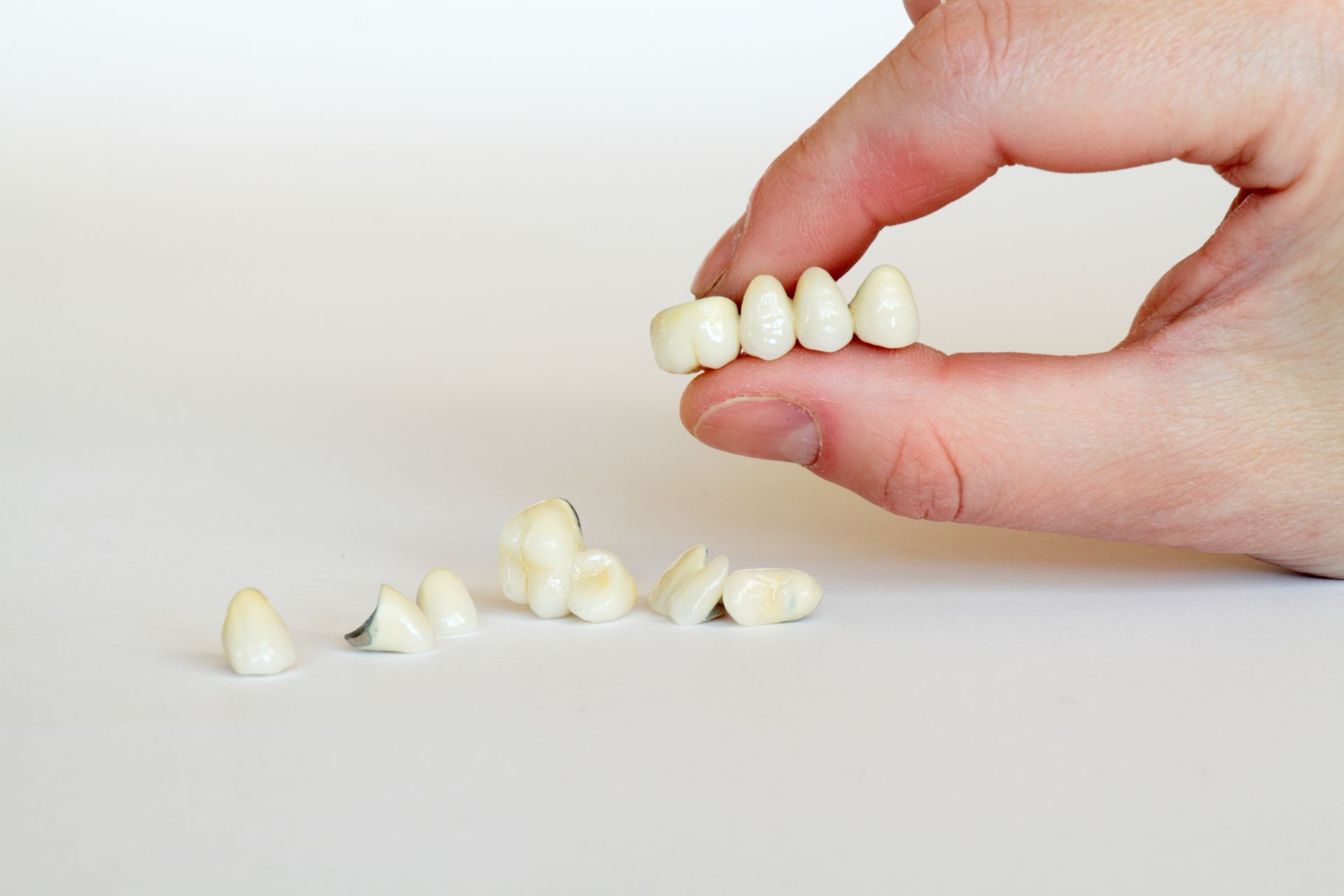
A dental crown is a cap that covers the visible part of a damaged tooth while the natural root stays in the jaw. A bridge is a false tooth, called a pontic, held in place by crowns on the teeth beside the gap. A traditional bridge is built from two crowns and one false tooth, which explains why the two get compared.
| Feature | Crown | Bridge | Implant with a crown |
|---|---|---|---|
| What it does | Covers and protects 1 damaged tooth | Replaces 1 to 3 missing teeth in a row | Replaces 1 missing tooth, root included |
| Works after an extraction | Only on top of an implant | Yes | Yes |
| Teeth that get reshaped | 1 tooth | 2 neighboring teeth for a traditional bridge | 0 teeth |
| How long it takes | 2 visits, or 1 visit with CEREC | 2 visits, with 2 to 4 weeks of lab time | 3 to 6 months for the implant to fuse |
| How long it lasts | 5 to 15 years on average | 5 to 15 years on average | Longer than a bridge in general |
Is it better to get a crown or a bridge?
Neither a crown nor a bridge is better across the board, because each fixes a different problem. A crown fits when the tooth can be saved. A bridge is the right choice when the tooth is already missing or has to be extracted and the neighboring teeth are strong.
Crown or bridge after a tooth extraction
After a tooth extraction, the choice is a bridge or an implant, because a crown needs a tooth or an implant underneath it.
Dentists treat tooth extraction as a last resort. If the root is sound, we would rather keep it and place a crown on top. Once a tooth is out, something has to replace the whole tooth, and waiting has a cost. The neighboring teeth can drift into the gap and tilt, which changes how your bite meets.
Take a lower molar that cracked below the gumline. The crack rules out a crown, so the tooth comes out. If the teeth on both sides already carry large fillings, a dental bridge makes sense, because those teeth may need crowns in time anyway. If both neighbors are untouched, grinding them down to hold a bridge is a real trade-off, and an implant deserves a look.
Can a crown replace a pulled tooth?
A crown alone cannot replace a pulled tooth, because a crown is a hollow cap that needs a base. The support is either a natural tooth or a dental implant placed in the jawbone. When people say they got a crown after an extraction, they mean an implant with a crown attached on top.
How long after an extraction can you get a bridge?
A final bridge usually goes in a few months after an extraction, once the gums and bone have healed. The wait gives the gums and the bone underneath time to recover. Healing time differs from person to person, so the date is set once the extraction site has been checked.
How long a crown lasts vs a bridge
A crown lasts 5 to 15 years on average, and a bridge falls in the same range.
With careful home care, some crowns stay in service for upwards of 30 years. A crown depends on one tooth, while a traditional bridge depends on two anchor teeth plus the joints between its parts.
Think of a bridge as a shelf resting on two brackets. The shelf itself can be in perfect shape and still come down if one bracket pulls out of the wall. Decay or a fracture in either anchor tooth can take the whole bridge with it, which is why the health of those two teeth decides how long a bridge lasts.
A systematic review in Clinical Oral Implants Research pooled long-term studies and found that 93.8% of traditional bridges were still in place at 5 years and 89.2% at 10 years. Cantilever bridges, which anchor on one side only, dropped to 80.3% at 10 years. The review dates from 2007, and bridge materials have changed since, so read the figures as a baseline.
Three habits shorten the life of either one: chewing ice, grinding at night without a guard, and skipping the floss around the margins.
Can a tooth rot under a crown?
A tooth can decay under a crown, because the natural tooth and root are still there beneath the cap. Bacteria get in at the margin where crown meets gum. Brushing and flossing around a crowned tooth matter as much as they do for any other tooth.
Red flags: call the office if you notice any of these.
- A crown or bridge that feels loose
- A bad taste or bad breath that stays
- A visible crack or chip
- Pain when you chew
Bridge vs implant when the neighboring teeth are healthy
When the teeth beside the gap are healthy, an implant spares them, while a traditional bridge requires reshaping both.
Reshaping removes enamel, and enamel does not grow back. Dental implants replace the root as well as the visible tooth, and in general they outlast bridges. An implant costs time, since the post needs three to six months to fuse with the jawbone. A bridge can be finished within a few weeks once the site has healed.
A bridge remains the stronger choice when the jawbone is thin, when surgery is off the table for medical reasons, or when the neighboring teeth already need crowns.
Bridge and implant planning at Oxboro Family Dental can involve Dr. Augusto Saldarriaga, a board certified prosthodontist on our team. Prosthodontics is the dental specialty focused on replacing missing teeth, and Dr. Saldarriaga is a Diplomate of the American Board of Prosthodontics who also teaches part time at the University of Minnesota School of Dentistry. His practice is limited to restorative dentistry and prosthodontics.
What are the disadvantages of a crown and bridge?
The main disadvantage of both a crown and a bridge is that healthy enamel has to be removed, and that step cannot be undone. A crown can chip, loosen, or let decay in at its edge. A bridge adds two more concerns: its anchor teeth can fracture or decay, and cleaning under the false tooth takes a floss threader.
Find out if a crown can save your tooth or if the tooth needs replacing.
Have your tooth looked at in Bloomington
Dr. Sara and her team will explain what can be done and why.
How many visits a crown or bridge takes
A lab-made crown or bridge takes two visits, and a same-day crown takes one.
At the first visit, the tooth or the anchor teeth are numbed and shaped, an impression is taken, and a temporary goes on. A dental lab then needs two to three weeks for a crown and two to four weeks for a bridge. At the second visit, the temporary comes off, we check the fit and the color, and the final piece is cemented.
Same-day crowns skip the lab. With CEREC, a camera scans the tooth, the crown is designed on screen, and a milling unit carves it from a ceramic block in 10 to 20 minutes. CEREC covers crowns, partial crowns, and veneers. A bridge still goes through the lab.
Key Takeaways
- A crown saves a damaged tooth, and a bridge replaces a missing one.
- After an extraction, the options are a bridge, an implant with a crown, or a denture.
- Crowns and bridges both average 5 to 15 years.
- The two anchor teeth decide how long a bridge lasts.
- A final bridge goes in a few months after an extraction, once the site heals.
Get a tooth replacement plan built around your gap, your neighboring teeth, and your budget, with costs quoted after an exam.
We participate with Delta Dental Premier, HealthPartners, Cigna, and Premier Dental Network.
FAQ
Is a bridge more expensive than a crown?
A bridge costs more than a single crown, because a traditional bridge is at least three connected units: two crowns and a false tooth. The total depends on the material, the number of missing teeth, and any work the anchor teeth need first. At Oxboro Family Dental, fees are quoted after an assessment.
Does a dental bridge damage nearby teeth?
A traditional bridge changes the nearby teeth in a way that cannot be reversed, because both are reshaped to hold the anchoring crowns. The reshaped teeth can decay or fracture later if plaque builds up around the bridge. An implant or a bonded Maryland bridge leaves the neighboring teeth closer to intact.
How many teeth can a bridge replace?
A bridge most often replaces one to three teeth in a row, and some replace up to four. Longer spans put more force on the anchor teeth, so they need healthy natural teeth or implants on both sides of the gap. For three or more missing teeth, an implant-supported bridge is one option to discuss.
How do you clean under a dental bridge?
Clean under a dental bridge once a day with a floss threader or a small interdental brush, because regular floss cannot pass through the connected teeth. Slide the threader under the false tooth and sweep along the gumline. Brush twice a day with fluoride toothpaste, and keep routine cleanings so we can check the anchor teeth.
Does insurance cover crowns and bridges?
Coverage for crowns and bridges depends on your plan, so the benefit has to be checked against your specific policy. Oxboro Family Dental participates with Delta Dental Premier, HealthPartners, Cigna, and Premier Dental Network, and accepts CareCredit payments. Bring questions to our office, and check with your insurance provider as well.